Stop digging tunnels
to test webhooks.
Catch every webhook, inspect the full payload, replay on demand, and mock any response — without exposing a port or babysitting a process.
No credit card required • Get 10 endpoints that don't expire for FREE
Real-time delivery
Webhooks appear in your browser instantly. No refresh, no polling — live WebSocket streaming.
First-class inspection
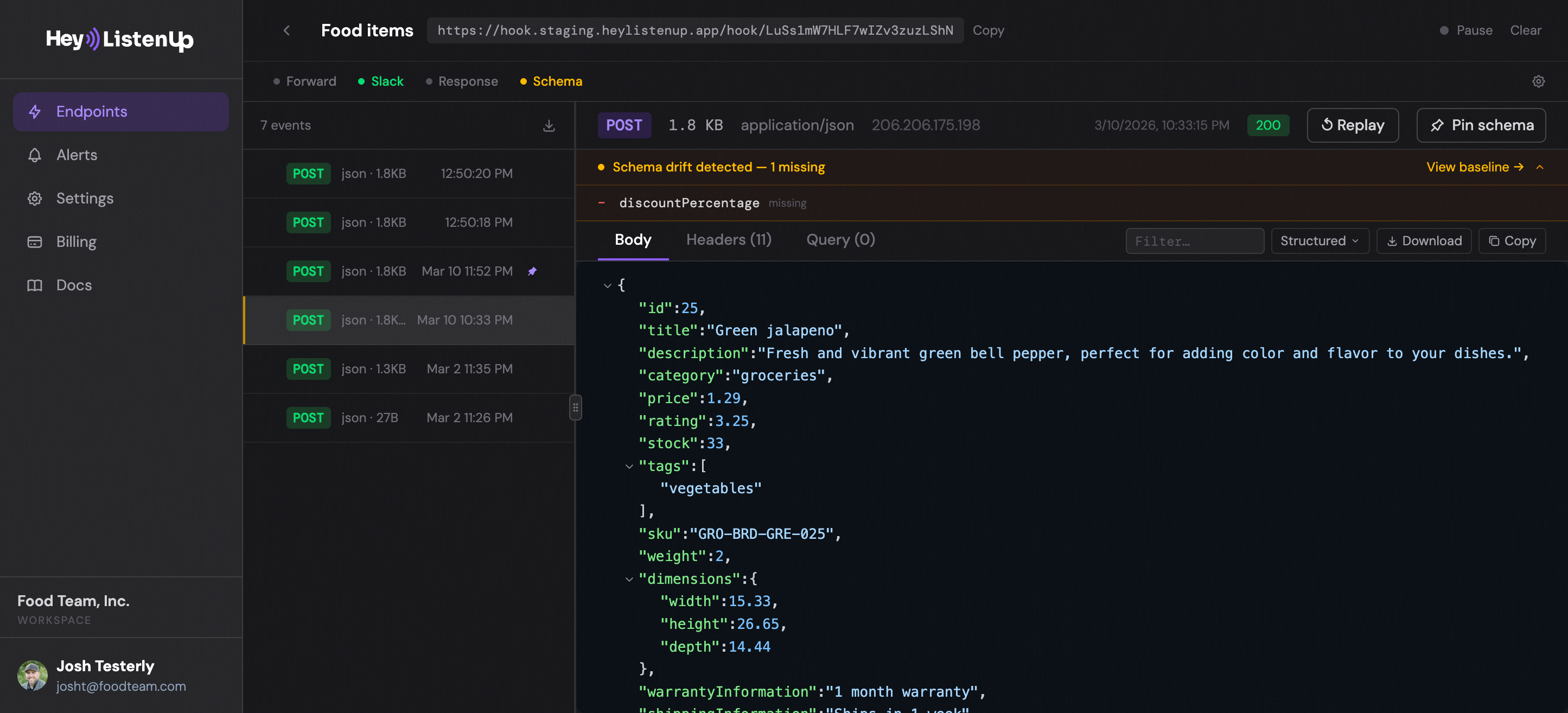
Syntax-highlighted JSON viewer, headers, query params, source IP — everything laid out clearly.
Up to 90-day history
Events persist across sessions. Come back days later and see exactly what arrived. Free accounts keep 7-days of history.
Event replay
Re-send any stored event to any URL. Debug your endpoint without waiting for the real thing.
Local forwarding
Forward live webhooks to localhost. No ngrok, no extensive tunnel config. Choose from browser relay or a dead-simple CLI tool.
Payload diff
Select any two events and see exactly what changed — field by field, with additions and removals highlighted.
Response mocking
Control exactly what your endpoint returns — status code, body, and headers. Test how senders handle retries and failures.
Permanent endpoints
Your endpoint URLs never expire or rotate. Give one to a service today and it still works a year from now — no re-configuration required.
Slack notifications
Get a Slack message the moment a webhook arrives, when schema drift is detected, or when an endpoint goes silent.
CSV / JSON export
Download your full event history in one click. Share with teammates, import into a spreadsheet, or keep a local audit trail.
Schema drift detection
Pin a baseline payload and get alerted when incoming webhooks add, remove, or change fields. Catch breaking changes before they break your app.
Absence alerts
Set a silence threshold on any endpoint and get notified via Slack when events stop arriving — before your users notice.
Time to first webhook
Every step it takes to see a live payload.
- 1 Install the binary
- 2 Authenticate the CLI
- 3 Start your local server
- 4 Run the tunnel command
- 5 Copy the generated URL
- 6 Paste into Stripe dashboard
- 7 Trigger an event
- 8 Hunt through terminal output
- 1 Copy your endpoint URL
- 2 Paste into Stripe dashboard
- 3 Trigger an event
- 4 See your payload
How it works
Tunnels are infrastructure.
HeyListenUp is a developer tool.
Get a URL. Plug it in to any service.
One click creates a permanent endpoint URL. Paste it into Stripe, GitHub, Shopify — anywhere. No binary to install, no port to open, no process to keep alive. It just starts receiving.
Read the payload, not the terminal.
Every event lands in a structured dashboard — headers, body, source IP, all syntax-highlighted, collapsible, and laid out clearly. Not a scrolling wall of JSON. Forward to your local server in one click with the Browser Relay, or run the CLI for a persistent background connection.
Fix it. Replay it. Done.
Found the bug? Fix your code and hit Replay — the exact same payload hits your handler again instantly. No waiting for the source to fire another event. Mock status codes to test how senders handle failures, without touching a line of code.
Two pain-free ways to forward webhooks to localhost.
Whether you want a quick listen or a persistent connection.
Free
Browser Relay
Click "Forward" on any endpoint in your dashboard, paste your localhost port, and go. HeyListenUp relays every incoming webhook through your browser tab — no installs, no config, no fuss.
- Zero setup — works instantly in-browser
- No tunnels, no ports to expose
- Included on all plans
- Requires an open Chrome or Firefox tab
Pro
heylistenup CLI
Install once, forward forever. The CLI keeps your connection alive even when your browser is closed — with auto-reconnect, an interactive endpoint picker, and clean terminal output.
$ npx heylistenup forward
- Runs without the browser open
- Auto-reconnect on disconnect
- Interactive endpoint creator/picker built-in
Test the "What-Ifs" without the stress.
Stop waiting for errors to happen. Create them.
Mock Any Status
Tell HeyListenUp to return a 400 Bad Request, 429 Too Many Requests, or a 500 Server Error to the sender. See exactly how your system handles retries and failures.
Custom Payloads
Need to test a specific edge case? Define a custom JSON body or custom headers for the response sent back to the source.
Instant Feedback
Switch from "Normal" mode to "Mocking" mode with a single toggle. No code changes, no redeploys.
One-click "Do-overs."
Stop waiting for the cloud to talk. Make it repeat itself.
The "Fix & Fire" Cycle
Caught a bug that crashed your server? Don't trigger a new event from Stripe. Fix your local code, hit Replay, and watch the exact same payload hit your localhost again instantly.
Targeted Retries
Replay events to specific environments. Send that tricky production payload to your local dev machine to see exactly where the logic failed.
History as a Test Suite
Your event history isn't just a log — it's a library of test cases. Replay "Payment Succeeded," "Subscription Canceled," or "Refunded" events whenever you're refactoring your integration logic.
See exactly what changed.
When your webhook payload silently evolves, you need to know. Select any two events for a field-level diff — or pin a baseline and let schema drift detection alert you automatically when the structure changes.
Multi-select & Compare
Tick any two events in the timeline — doesn't matter how far apart they are. HeyListenUp diffs the payloads instantly, no copy-paste required.
Field-level Precision
Added fields glow green. Removed fields show red. Changed values display both old and new inline. You see the full structure, not just the delta.
Catch Silent Breaking Changes
Third-party APIs change their payloads without warning. Diff a recent event against an older one and spot the new field — or missing one — before it crashes your production handler.
Stop tunneling. Start listening.
Join the developers who inspect real payloads instead of relying on outdated docs.
Get started — it's free